
Lois Weber's Hypocrites (1915)
A masterful and sweeping meditation on truth and hypocrisy

I am there in the busy crowd. We wait with trembling breaths for the unveiling. What do we expect to see? The monk Gabriel has invited us here. He will draw back the curtain on what he has created, on the fruit of his many hours of labor. We are asking him for an amusement or a diversion, something to keep the bubbles of our daily pleasures in a fine froth. Ordinary life is too ordinary, so please entertain us.
That is how I imagine myself awakening amidst this passage from Lois Weber’s 1915 film Hypocrites. Depending on the edited version you watch, the above sequence comes either at the start of the film or the middle stretch. Either way, this masterful passage lies at the heart of Weber’s cinematic vision.
The movie, in fact, prefaces that segment with these titles that adequately capture the whole film’s rich complexity : “Gabriel the ascetic…a legend…with prayer and fasting he reverently formed his idea of Truth.” Gabriel is in many ways a heroic figure in this film, but Weber is wise enough to frame him as human with her noted emphasis on “his” idea of Truth. The ascetic, as it turns out, has been crafting a sculpted picture of Truth in the spirit of the 1914 Adolphe Faugeron painting La Vérité (The Truth).
In interviews, Weber credited the Faugeron painting with being the inspiration for her film. In the painting, an unclothed woman is standing upright and holding a bright beacon in her upraised arm. Dozens of onlookers are seen either looking away, turning away, or perhaps even collapsing in shock from what they have seen. In the film, Gabriel has also sculpted his Truth in the form of a naked woman. When the crowd sees it, some of them gather to attack and kill Gabriel with a spear. Despite their frenzied attempts to do the same to the sculpture, the female form vanishes before their eyes as we see these words on the screen : “Truth departs from the people.”
This scene is cinematic lightning for many reasons. Beginning with its artist-monk Gabriel, we are faced with a complex and moving figure who is trying to make sense of the world and express himself in it. He is a religious figure with a seeming impulse to express his faith by way of his artistic vision. If I could only bring the idea of Truth before the people, he is thinking, they would be rescued and safe. Our title reads, “Gabriel asked permission to present Truth to the people.” For artists and theologians alike, the idea of bringing forth a vision of Truth is a deeply powerful one.
Then we have the reactions to the Truth that is presented. These are part of the film’s deep rumination on truth and how it is presented and received. Most of the onlookers are incensed and move to attack. Some jeer and laugh. Others could care less. A precious pair of women are cut to the heart and receive the truth with soft hearts. We also note one little girl is looking on with childlike wonder at what is being unveiled. We think here of Jesus’s words in Mark 10:15 : “Truly I tell you, anyone who will not receive the kingdom of God like a little child will never enter it.”
There is also the technical brilliance of this sequence. The compositions teem with all varieties of human experience. Faces comment on faces that comment on other faces. The camera pans smoothly over scores of people, first as they get ready to see the display and then after they have seen the curtain drawn aside. This is the world, and Weber’s camera is here to take it all in. This is a bold cinematic vision of a world set on fire by Truth itself.
The rest of the film may be a lower key of masterful, but it is fantastic nevertheless. Other segments in the film involve Gabriel in the form of a modern-day (early 20th century) church minister preaching to his congregation from Jesus’s words on hypocrisy : “In the same way, on the outside you appear to people as righteous but on the inside you are full of hypocrisy and wickedness.” (Matthew 23 : 28) The reactions of the church members echo the responses of the medieval crowd to the unveiling of the Truth statue. There is some anger, but also much boredom and apathy.
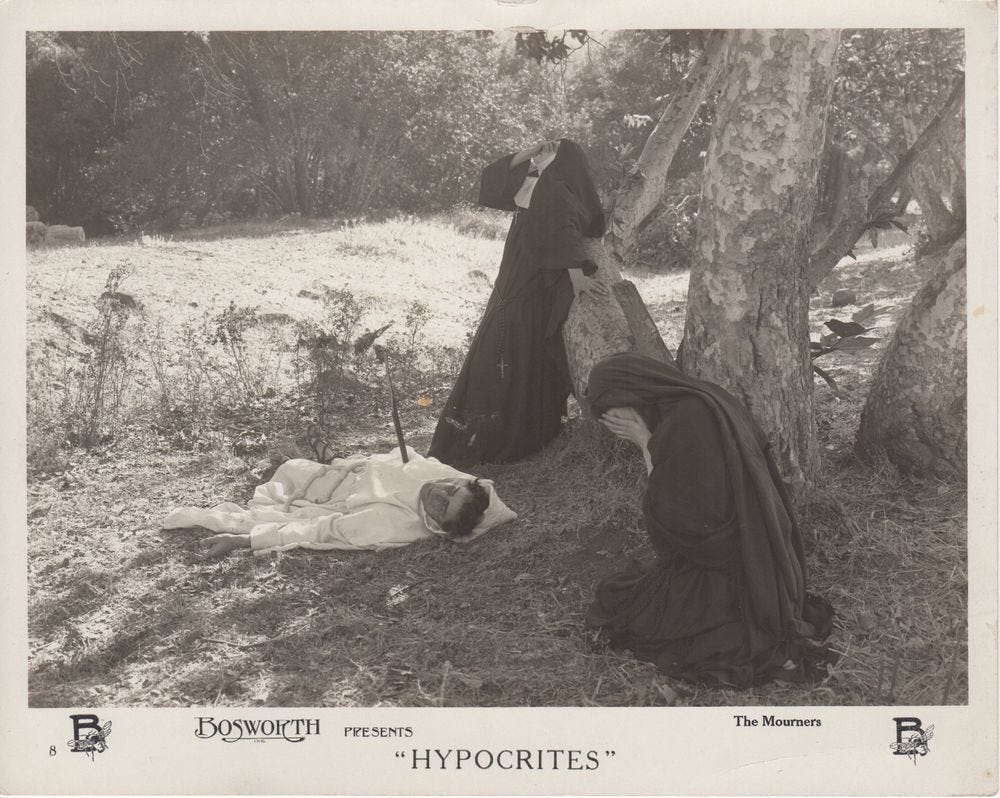
At one point, the modern minister becomes weighted down with the response to his sermon and collapses in a chair. Whether in a dream or an alternate reality, we see him in a monk’s cassock trying to lead his followers on a steep and narrow road. Most of those who start out following on the path find some reason not to start the climb up the hard part of the trail. Just two women, echoing the two humblest figures in the unveiling sequence, are brave enough to ascend with the valiant leader.
This version of Gabriel may imagine himself leading disciples on a path like the one Jesus talked about : “Enter through the narrow gate. For wide is the gate and broad is the road that leads to destruction, and many enter through it. But small is the gate and narrow the road that leads to life, and only a few find it.” (Matthew 7:13-14) Gabriel is a bold leader, yes, but we are shocked to find that he barely even notices when his two followers are fainting from exhaustion and calling out for help.
In an unforgettable moment, one of the women calls out clearly for help (“I need your hand”) as she falters on the climb to the mountaintop and yet the minister does not offer her that hand of help. He is too busy pursuing the uphill climb to find Truth. The woman, essentially forgotten by a leader whose hands are too busy with holy pursuits, becomes a black shadow. Her body, almost a negative space, kneels with arms pleadingly raised upwards toward the help that is never given. A river rushes in the backdrop of her devastated form, and with that water seems to flow every action that ever strained toward truth but left behind love.
We are reminded at this point of the title of the film. Who are the hypocrites in this movie? Some of them are those church members who sit and listen to the sermon on hypocrisy and yet scheme behind the minster’s back to get him fired. Some of them are those who come to the unveiling of the statue to see beauty and truth but end up trying to tear the truth to shreds. One of the hypocrites, though, may very well be the minister himself who is not able to extend his hand to help those he is wanting to lead to Truth. It is a mark of the film’s deep maturity that the film can recognize this hypocrisy and still see the honor in this man’s pursuit of Truth in so many other ways. Could it be that Gabriel, like Peter in the Bible, could be ultimately forgiven for abandoning a friend at the hour of trial? In a later scene in which he goes through the gates of Truth more humbly than he did the first time, we can imagine that there may be forgiveness even for him.
The subject of the minister’s pursuit of Truth brings us to the film’s most daring stylistic choice. Once we see Gabriel reach the summit of the mountain, we follow him through a forest as he himself follows Truth. Truth is embodied as the faint shimmer of an unclothed woman. This is an echo of Gabriel’s own sculpture, but the film actually uses a real actress (painted in a shimmer by many exposures that were a tremendous film innovation at that moment) as the minister tries to follow her. “Truth is ever elusive” is the message we see on the screen as he follows after her.
What are we to do with this use of female full-frontal nudity? This was in fact just about the first-ever example of such nudity in a film. I myself am quick to criticize modern films for scenes of gratuitous nudity that do not serve a clear purpose. Why, for example, does Wes Anderson need full-frontal female nudity in a film like Asteroid City? Maybe it is a double standard, but I am very ready to accept the nudity in Hypocrites as integral to what the film is doing.
The film’s inspiration was the Faugeron painting which itself used an unclothed woman to represent Truth. Following the example of the painting, the film uses the nudity in a way that speaks of beauty and purity rather than anything sexual. It is clear that the minister is not following the figure of Truth at all in a sexual way, and in fact the scenes with the nude actress were filmed with only Lois Weber present (the figure was superimposed on the Gabriel scenes later). The film also helps us to accept the nudity with this John Milton quote from his 1644 Areopagitica :
“Truth indeed came into the world with her Divine Master, and was a perfect shape most glorious to look on; but when He ascended, and His apostles after Him were laid asleep, then straight arose a wicked race of deceivers, who took the virgin Truth, hewed her lovely form into a thousand pieces, and scattered them to the four winds.”
Here were are, then, with a clear line being drawn between the film’s vision of Truth and the truth that Jesus brought into view in the gospel accounts of his life and words. The hewing of Truth into a thousand pieces could be pointing to the idea of hypocrisy which is found in so many forms in the film. Weber seemed to be pointing to hypocrisy as an enemy of truth. As a Christian director herself she appears to have crafted this onscreen fable as a picture of what Jesus meant when he talked of whitewashed tombs; crypts that are beautiful on the outside but are in fact full of dead men’s bones.
The film leaves me asking myself this potent question : What do I do when faced with unadulterated truth? This truth could be in a political form, an emotional or relational form, or it could come in the form of spiritual truth I find in the words of Jesus. Will I rush the stage of the truth being presented and be tempted to kill the messenger as in this film? Will I sulk off into the distance, too bored or apathetic to care that I am being challenged? Will I pretend to follow the truth when all I am really doing is hiding dead man’s bones? Or am I ready to embrace the truth humbly, especially if it is truth that is uncomfortable?
The final shot of this film is that of a glimmering cross. The cross lingers in the frame just seconds longer the calamity it is hovering over. We could almost miss it, but there is no doubt Weber intended it to hang in the air once all else had faded. In the brutal battle between truth and hypocrisy, we often wonder which side will win. With that cross, the film seems to be declaring a victory that was decided hundreds of years ago on another kind of hill. Like Gabriel’s followers, many of us have tried to follow Jesus up that narrow road but have collapsed into the shadows along the way. Unlike Gabriel, though, we can see Jesus as one whom we follow up that narrow road but who also extends the hand to bring us up with him.
I need your hand, we say.
The loving hand, the one that smashes all hypocrisy, is given to us.